Unstressed Vowel in the Word Again
Vowels in unstressed syllables
A common fault is to transcribe full vowels for English unstressed syllables. If you transcribe assistant as [bæ nænæ], you are claiming that all three vowels are identical (except in loudness). Even in the slowest and most conscientious pronunciations, this isn't true. What symbol should be used instead?
 The short, sort of accurate, answer is: all unstressed syllables in English have the "schwa" [ ]. The exceptions are that final unstressed syllables tin can sometimes have full vowels (east.g., potato ) and [i] can often be unstressed even in the center of words (e.g., radiate).
The longer, more authentic answer relies on the distinction between narrow and broad transcription.
Unstressed vowels in English are quite variable. The same speaker will pronounce the vowel [ ] in the second syllable of enough much the aforementioned way every fourth dimension, but the schwa in the first syllable can be pronounced very differently on different occasions, sometimes even resembling full vowels like [
 ], [
], [ ], or []. [Notation]
- If we are interested in making narrow transcriptions, we could record the subtle variations for each utterance.
- But if we are interested in a broad transcription, we will ignore them: nosotros will but want to record those differences in audio which tin impact the pregnant of a discussion, and in English none of the variation in the first syllable will crusade enough to mean something else. Then for a broad transcription we use a single cover symbol for all the variations of the unstressed vowel, namely [].
Schwa and R
In broad transcriptions, Rogers transcribes the "er" sound of words like fur/fir as [  ], even when this occurs in a stressed syllable. This option has the initial advantage for many learners that all you have to practise is turn the more familiar "er" upside down. It has the disadvantage that it's not an accurate reflection of what the mouth is doing. The consonant [] is made past curling the tongue tip upwardly. In a give-and-take like fur, the tongue tip is already curled up past the end of the [f], usually before. In that location is only no slice of fourth dimension between the [f] and the [] that we tin call a vowel.
 Ane mutual solution to this problem is to transcribe the "er" audio with the special IPA symbol [ ]. Unfortunately, there are no special symbols to solve the similar problem with [n], [l], and [m] -- for example, in normal speech there is simply no vowel between the [t] and the [north] of button, despite the usual wide transcription
 ![[b^t6n]](https://home.cc.umanitoba.ca/~krussll/138/sec1/button1.gif) . Nosotros will render to this problem later in the course when nosotros discuss "syllabicity". For now, it'due south easiest to continue using schwas in broad transcriptions of words similar these.
. Nosotros will render to this problem later in the course when nosotros discuss "syllabicity". For now, it'due south easiest to continue using schwas in broad transcriptions of words similar these.
A dialect glitch
Many speakers of English language accept intuitions that there are two dissimilar unstressed vowels and irresolute one for the other can alter the pregnant of the word. 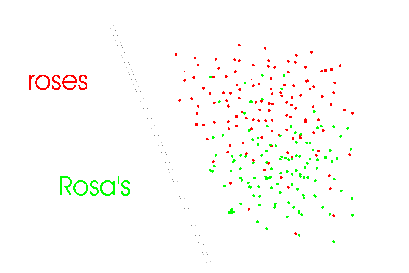 The classical minimal pair to illustrate this distinction, in dialects that make information technology, is rosedue south versus Rosa's. You could record a speaker of such a dialect saying roses and Rosa'south a hundred times each and plot on a graph the position of the speaker'southward natural language during the final vowel. In that location would be a large cloud of different positions for roses and a large deject of positions for Rosa'south -- in that location would be a large area where the two clouds overlapped, but information technology would still exist clear the clouds had dissimilar centres.
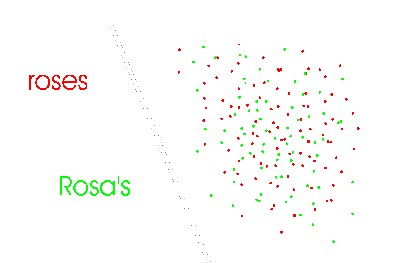 If you did the aforementioned graph for a speaker of a dialect that doesn't make this distinction (like me), the two clouds would overlap so much that there would exist no justification for maxim that the two words had different vowels.
In transcribing roses and Rosa's, the difference betwixt narrow and broad transcription is again relevant.
- For a narrow transcription of a detail utterance, you would record the unstressed vowel every bit accurately every bit possible. If utterance 27 of roses was the same as utterance 83 of Rosa'due south, the two would exist transcribed the same way.
- For a broad transcription, y'all would pay more attending to the central positions of the two clouds, which suggest how the 2 words are generally pronounced.
The transcriptions in the textbook fall somewhere in between. Rogers generally uses schwa for the vowels of unstressed syllables, just occasionally uses [] in words where dialects which make the schwa/barred-i constrast would use barred-i, eastward.g., relax. (This is non entirely consistent. Even if a speaker does have ii clouds for their unstressed vowels, the grounds for identifying the college cloud with the vowel of hit are no stronger than the grounds for identifying the lower cloud with the vowel of loving cup.)
In my transcriptions, I volition simply utilize [] for neutral unstressed vowels, i.e., for all unstressed vowels that are not full vowels, like the [i] in happy or [o] in potato . On assignments and tests, using schwa in broad transcriptions will always be acceptable. It'south also a good habit to get into, as one way of unlearning habits that might carry over from English language spelling.
Note: On some occasions, the ii vowels of enough can be pronounced extremely similarly, especially when the discussion is beingness pronounced with unnatural slowness or exactness or with more than emphasis on the commencement syllable than it gets in normal speech. Writing [
] every bit [] in a broad transcription is an easy trap to fall into if you are not careful to pronounce the word with normal speed and normal carefulness. Next: Song tract beefcake
Previous: Transcriptions -- kinds, suggestions, mistakes
Upward: Table of contents
winstonhatomentand.blogspot.com
Source: https://home.cc.umanitoba.ca/~krussll/138/sec1/trans2.htm
0 Response to "Unstressed Vowel in the Word Again"
Post a Comment